
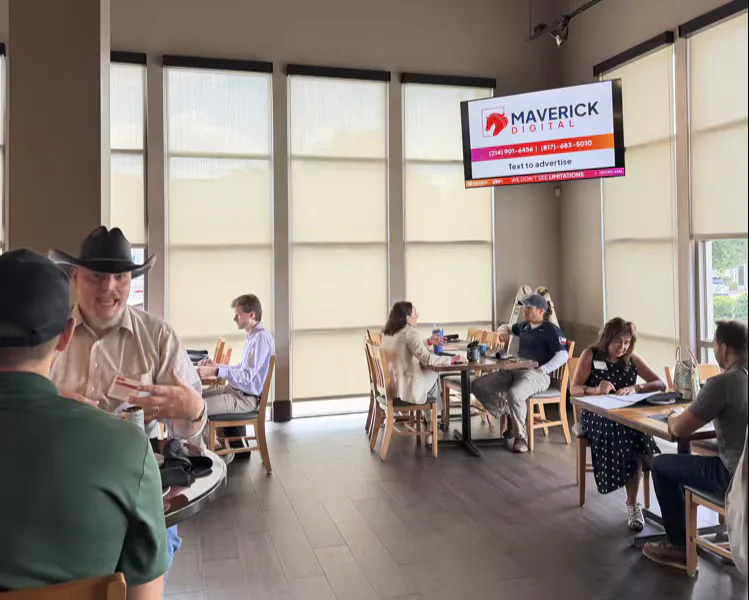
Any company can buy a hundred thousand online impressions in two clicks. So you would expect reach to be what wins. In North Dallas, we keep seeing the opposite: the businesses growing steadily are the ones customers run into in their own neighborhood, not the ones with the widest ads.
We call it the proximity paradox. The more connected the world becomes, the more people value a business that is physically, credibly present where they live.
Why distant ads get filtered out
Most people are overloaded. Notifications, feeds, streaming and email add up to thousands of commercial messages a day, and the brain copes by filtering — banner blindness. An ad that feels generic or algorithmically pushed into a feed gets tuned out before it is read.
An ad seen inside a place you visit every week is processed differently. It is part of your surroundings, not an interruption of your screen.
The mere exposure effect
Psychologists have studied this since the 1960s. Robert Zajonc’s research on the mere exposure effect, first published in 1968, found that people come to prefer things simply because they have seen them repeatedly. Nothing about the message has to change. Familiarity alone builds a sense of trust.
For a local business, that means the customer who has seen your name every morning at the coffee shop in Farmers Branch, or between sets at a gym in Plano, already leans toward you before they need what you sell.
How familiarity becomes a search
Picture two home service companies competing for the same neighborhood.
The first spends everything on search ads for “contractor near me” and asks every customer to compare it against a page of strangers.
The second pairs local search with steady visibility inside the community, within a ten-mile radius of its office. When a resident needs the service, they do not search the category. They type the second company’s name.
That branded search converts better, costs far less to win, and tells Google which business is the local leader.
We saw the effect directly in our $68,000 case study: once indoor screens and geofencing had made the brand familiar, the landing-page conversion rate rose 3.4 times, because visitors were arriving already knowing who they were dealing with. That is one client’s result over 60 days, not a promise, but it is the proximity paradox in a number.
Putting it to work
Being nearby only helps if both halves are in place:
- Presence. Our indoor billboards put your brand inside the venues your customers return to every week.
- Readiness. When that familiarity turns into a search, your Google Business Profile and website have to be the obvious next step.
- Focus. Spend only inside the area you can serve. Impressions two counties away build nothing.
You do not need to be everywhere. You need to be somewhere your customers already are, often enough to be remembered.
Want to see which venues sit closest to your customers? Get in touch or call (214) 901-6456.